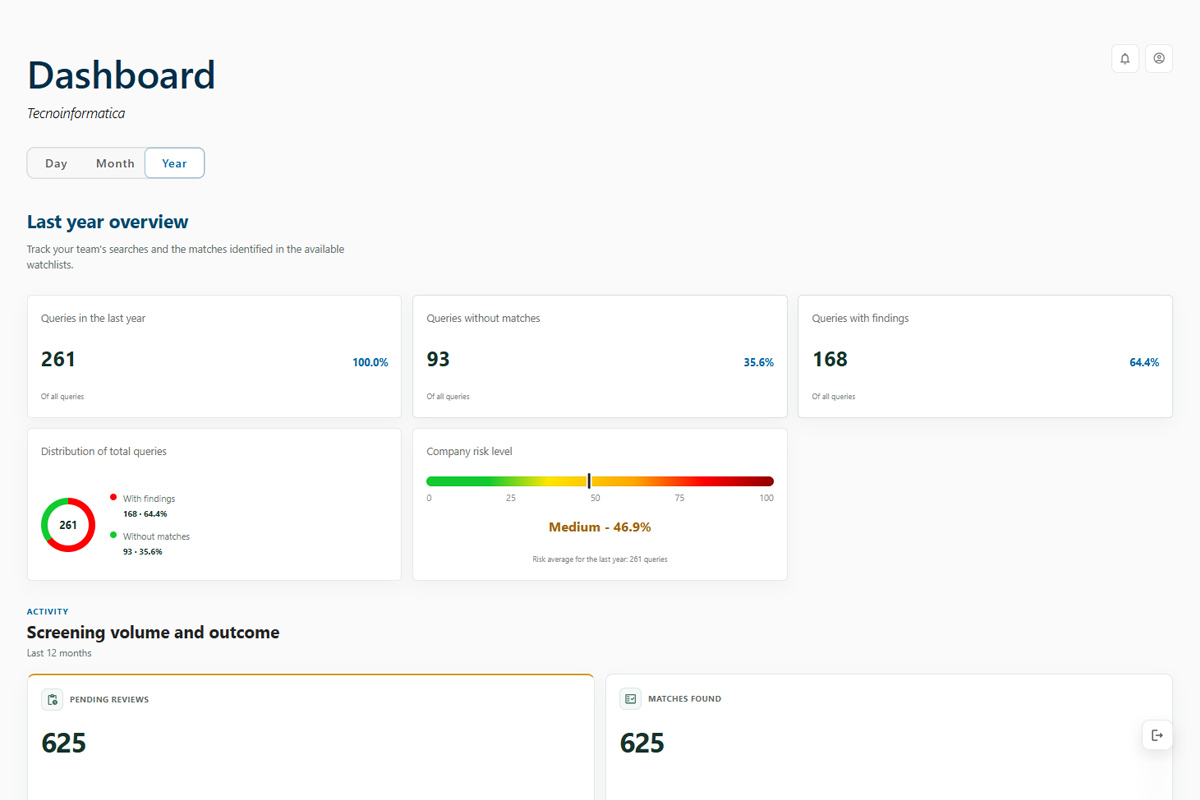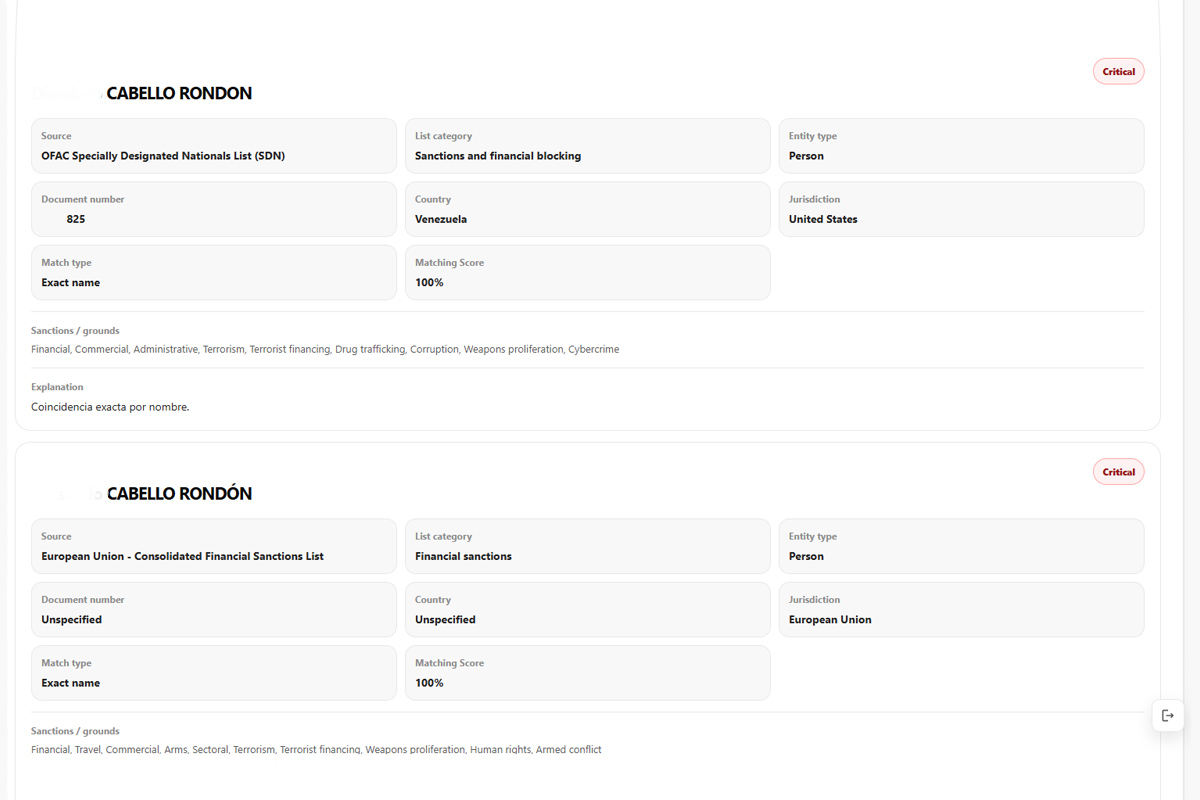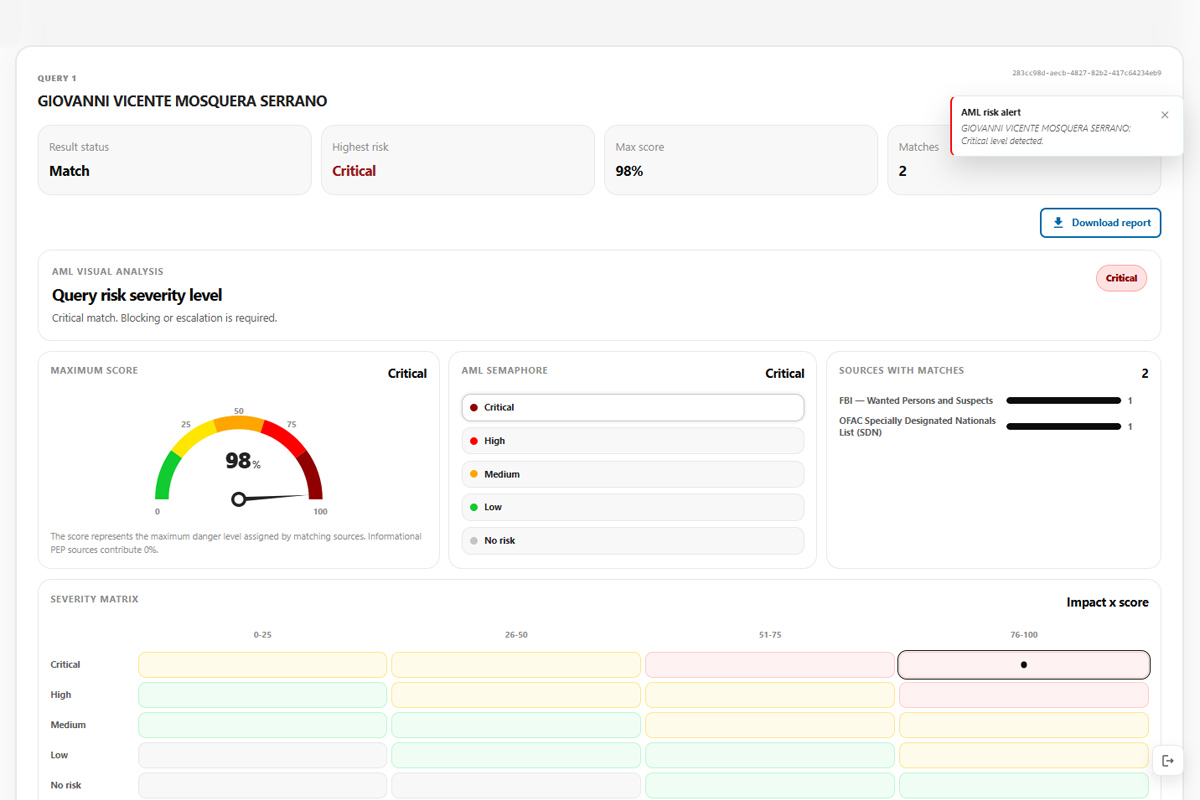
How does Screening work?


Screen individuals and businesses against watchlists, PEP databases, sanctions lists, and other relevant sources.

Assess your customers, suppliers, employees, business partners, and other counterparties before and throughout any business, employment, or contractual relationship.

SCREENED COUNTERPARTIES

AML SCREENING

SCREENING RESULTS

Key Features

Explore the platform’s features, functionality, and capabilities

Listas Nacionales e Internacionales

Global Watchlist Coverage

Screen against national and international sanctions and restricted-party lists.

Analisis de coincidencias

Match Analysis

Compare, review, score, and classify potential matches.

Personas Expuestas Politicamente

PEP Screening

Identify Politically Exposed Persons and related parties to strengthen counterparty risk assessments.

Monitoreo periodico

Ongoing Monitoring

Schedule recurring screenings to identify changes involving customers, suppliers, and other third parties.

Online 24 - 7 - 365

24/7 Availability

Access the platform whenever you need it, every day of the year.

Trazabilidad-Historial

Audit Trail and Traceability

Maintain a complete history of screenings and results to support monitoring, internal controls, and audits.

Frequently Asked Questions (FAQs)

Get answers to your most common AML screening questions.

What is AML Screening?

Screening AML is the process of checking individuals and companies against restricted-party lists, sanctions lists, Politically Exposed Persons records, background sources, and other relevant databases. Its purpose is to identify potential warning signs before starting or continuing a business, employment, or contractual relationship.

Why should organizations screen against restricted-party lists?

Restricted-party screening helps determine whether an individual or company appears in connection with sanctions, unlawful activity, reputational risk, or other matters relevant to due diligence. The results help the organization assess the counterparty and make decisions based on the identified level of risk.

Which lists may be included in AML Screening?

AML Screening may include domestic and international sanctions lists, restricted-party lists, terrorism-related lists, Politically Exposed Persons records, legally relevant background sources, and other compliance databases. Coverage should be defined according to the country, industry, operations, and internal policies of each organization.

What is a Politically Exposed Person or PEP?

A Politically Exposed Person, or PEP, is an individual who holds or has held a prominent public function and may therefore present heightened exposure to certain risks. Depending on the applicable rules, the assessment may also include family members, close associates, and related entities.

Who should undergo AML Screening?

AML Screening may be applied to customers, suppliers, employees, candidates, partners, shareholders, ultimate beneficial owners, legal representatives, contractors, and other counterparties. The scope should follow the organization’s risk-based approach and onboarding policies.

When should a counterparty be screened?

Screening should be performed before establishing a relationship and updated throughout its lifecycle. It may also be repeated when data, risk level, ownership structure, or the underlying screening sources change.

What happens when a match is found?

A match does not automatically mean that the screened individual or company is the same party shown in the source record. The result should be reviewed using additional identifiers such as full name, identification number, date of birth, nationality, location, and related entities. It may then be classified as a false, potential, or confirmed match.

What is the difference between a match and an AML alert?

A match is a similarity detected between screened data and a source record. An AML alert is the event created so that the match can be reviewed, analyzed, and documented before a risk decision is made.

Does AML Screening replace due diligence?

No. AML Screening is one component of due diligence. It does not replace identity verification, beneficial ownership assessment, business activity review, source-of-funds analysis, geographic risk assessment, or understanding the purpose of the relationship.